Exercises you need to complete. The instructor checks them off after successful completion.
Začetni tečaj
Cilj: tehnično pravilno vzletanje in pristajanje ter razumevanje osnov mehanike vodenja jadralnega padala.
✓Vaja 1: Priprava jadralnega padala za vzlet razprostiranje krila · razpletanje in priprava vrvic · namestitev in zapenjanje letalnega sedeža · pripenjanje padala na letalni pas · pet kontrolnih točk
✓Vaja 2: Dvig krila polnjenje in dvig krila · stabilizacija in kontrola · zaviranje do podiranja krila za pilotom · vodenje krila po tleh s spremembo hitrosti in smeri · kontrolirana prekinitev vzleta · vzvratni dvig krila · vse v različnih pogojih terena in vetra
✓Vaja 3: Vzlet, let in pristanek določitev smeri vzleta in postopno večanje hitrosti krila · vzlet v pokončnem položaju, let naravnost, pristanek z zaviranjem in tekom · pristanek s prevalom (simulacija) · nameščanje v sedež in pravočasen izhod iz sedeža · uravnavanje hitrosti, smeri in višine v fazi pristajanja · vzlet in let z bočnim vetrom · odpiranje zaprtega krila (simulacija pri vodenju po terenu)
Vaja 4: Vodenje — zavoji odprti (90°) in zaprti (180°) zavoji samo s krmilnimi vrvicami · zavoji v kombinaciji z nagibom telesa · zavoj z vetrom in zavoj proti vetru
Nadaljevalni tečaj
Cilj: samostojno in varno letenje v optimalnih meteoroloških pogojih. Za pristop k izpitu: najmanj 50 višinskih letov (nad 300 m višinske razlike) na petih različnih vzletiščih. Med leti je obvezna radijska zveza z učiteljem.
✓Vaja 1: Spretnostne vaje krmiljenja krila na šolskem terenu ground handling v močnejšem vetru (15–25 km/h) · vzlet z vzvratnim dvigom krila · pristanek na pobočju · pristanek in porušitev krila v močnejšem vetru
Vaja 2: Zavoji odprti in zaprti zavoji nad ravnino · upočasnjeni ploščati zavoji ob pobočju · zaprti zavoji ob pobočju (osmice) na varni razdalji od pobočja
Vaja 3: Kroženje kroženje v levem in desnem zavoju · izmenično kroženje v levo in desno · let po osi: 360° v levo in 360° v desno, oba končana v osi leta, skupaj v manj kot 35 sekundah
Vaja 4: Vaje nadzorovanega nihanja nihanje jadralnega padala po prečni osi · nihanje po vzdolžni osi · uravnavanje leta
Vaja 5: Pospešen let uporaba nožnega pospeševalnika s korekcijo smeri
Vaja 6: »Ušesa« — postopek hitrega spuščanja simetrično zapiranje koncev krila za večjo hitrost spuščanja · zavijanje levo/desno z nagibom teže v sedežu · kombinacija z nožnim pospeševalnikom
Vaja 7: Vodenje z zadnjima nosilnima trakovoma nadomestni način vodenja z zadnjimi nosilnimi trakovi in nagibom v sedežu
Vaja 8: Enostransko zapiranje jadralnega padala in reševanje simulacija zapiranja s potegom zunanjih nosilnih vrvic A-linije · aktivno reševanje po postopku
Vaja 9: Pristajalni postopek iz zaprtih zavojev zaprti zavoji (180°) · v omejenem prostoru prehod v let naravnost proti vetru v pristanek
Vaja 10: Pristajalni postopek »pristajalni zavoj« tri stranice: let z vetrom (vzporedno s pristajalno linijo, indikacija vetra in zniževanje) · prečno letenje · finale proti vetru z vzravnavo v sedežu, zaviranje največ 50 %
Vaja 11: Priprava na izpitni let izvedba elementov, predvidenih v vsebini izpitnega leta
Source: paraglider pilot training program (FCL.PRG-1), Slovenian Civil Aviation Agency —
caa.si
Exam questions
The quiz is available to course participants in My Course. For everyone else, it's open on the page
Exam questions →
To successfully pass the exam, you need at least 80% in each subject, and 100% in Emergency Procedures.
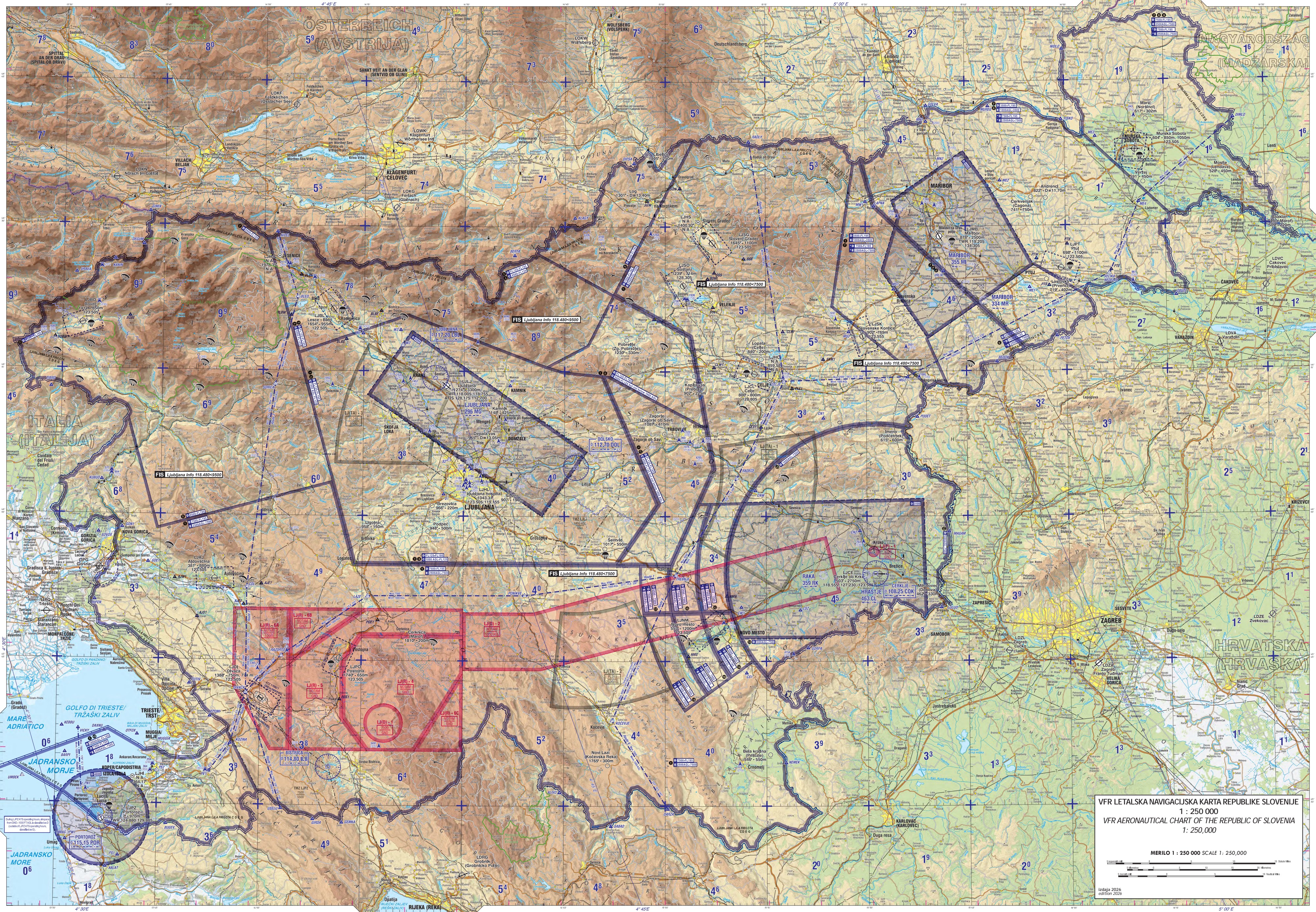
Click opens the map in full resolution. Source: VFR aeronautical navigation chart of RS 2026, Slovenia Control (AIM portal).
Answered
Correct
Success rate
Subject
Answered
Correct
Success rate
Threshold
✓✗…
A-01 · Which body of the same frontal cross-section and at the same speed offers least drag?
A-02 · Which body of the same frontal cross-section and at the same speed offers most drag?
A-03 · We describe laminar airflow as :
A-04 · How does the profile of a paraglider get shape ?
A-05 · Where does the force of gravity pull?
A-06 · The drag is pulling in the direction of:
A-07 · Which force is pulling against the force of gravity during the glide?
A-08 · What is the glide angle ?
A-09 · What is the name of the resultant of the lifting power and the drag?
A-10 · The lift is pulling :
A-11 · At what angle, regarding to the airstream, the lift is pulling?
A-12 · Which factor is irrelevant for the lift force?
A-13 · Which factor is irrelevant for the lift force?
A-14 · Which factors are important for the lift force?
A-15 · How the lift is distributed over the wing?
A-16 · With asymmetric airfoil:
A-17 · With Every lift producing airfoil the airstream over the upper surface is:
A-18 · The lift is result of :
A-19 · Which statement is correct?
A-20 · What is the correct distribution of lift on a bent asymetric airfoil?
A-21 · Where on the paraglider do we find mostly negative pressure?
A-22 · The leading edge of the airfoil during the glide is facing:
A-23 · Thick and strongly bent airfoil provides:
A-24 · What do we achieve with shortening of the A lines?
A-25 · What is true when we push accelerator (speed bar):
A-26 · What is true when we push accelerator (speed bar):
A-27 · Trimmers on the paraglider:
A-28 · If the rear lines of the glider are shortened:
A-29 · What can happen if A and B lines are streched?
A-30 · How does the center of pressure move as we increase the angle of attack?
A-31 · While flying slow we increase angle of attack, so:
A-32 · Danger of loosing the lift is especially serious:
A-33 · When pulling brakes for too long it is dangerous:
A-34 · During Full stall:
A-35 · What can increase the gliders tendency to stall?
A-36 · What can happen if the brake lines are set 40 cm too short?
A-37 · What happens if brake lines are set 15 cm too long?
A-38 · From wings polar curve we can see :
A-39 · In the polar curve the highest sink is at point (enclosure nr. 2) :
A-40 · Which is the point ob the best glide (enclosure nr. 2) ?
A-41 · What is true about the best glide speed?
A-42 · Usually the glider has the best glide or the best sink while flying as follows:
A-43 · When glider is flying at the best glide speed:
A-44 · Glide angle number tells:
A-45 · What is the glide ratio of the glider, which in calm conditions flies 4.2 km distance from 600 m relative altitude?
A-46 · Glider flies in calm conditions 900m distance from 300m relative altitude. How far can it fly from 2100 m of relative altitude?
A-47 · How does the glide ratio of a glider (4 in no wind at 30 km/h air speed) change , when flying at the same settings and tail wind of 30 km/h?
A-48 · If the air speed is 34 km/h and there is a17 km/h of head wind:
A-49 · The speed range of the paraglider is:
A-50 · What is air speed?
A-51 · Which is the most important speed for flying?
A-52 · Does during glide flying forward necessarily mean flying down too (relative to the surrounding air)?
A-53 · If pilot flies without braking :
A-54 · What speed should a pilot fly at in a thermal to reach max. Climb?
A-55 · How should a pilot fly in wide, weak thermals?
A-56 · Basic setting of the construction angle of attack should provide:
A-57 · Increased wing load causes:
A-58 · How does the higher wing load affect the speed?
A-59 · How does the higher wing load affect the min. Speed?
A-60 · Heavier pilots fly relative to the lighter pilots (with the same glider):
A-61 · Which drag affects the glider during the flight?
A-62 · Equalizing of pressures on the wing tips causes:
A-63 · How can we reduce the induced drag?
A-64 · With increasing aspect ratio we induce:
A-65 · Swing stability means:
A-66 · At sudden gusts of wind or when entering a strong thermal, the resulting torque swings the glider around:
A-67 · Very tight (too short) chest strap of the harness:
A-68 · Advantages of low hook in points on the harness are:
A-69 · Consequences of low hook in points on the harness are:
A-70 · Solidity of an airfoil depends on:
A-71 · The drag of the body, at the same angle of attack, is increasing with speed:
A-72 · How is the drag changing as the speed doubles?
A-73 · Does the drag coefficient change, if the speed doubles, and if it does, how much?
A-74 · the drag, caused by the airflow, changes with surface of the wing (at the same speed):
A-75 · How does the drag change with double surface of the body and at the same air speed ?
A-76 · Flying in turn automatically means:
A-77 · which is the additional force, working in the turn, compared to the straight level flight ?
A-78 · what is happening with wing load in the turn (compared to the straight flight)?
A-79 · when does the flight preparation beggin?
A-80 · What does the flight preparation include?
A-81 · Take off place must be chosen so that:
A-82 · When do we execute five control points procedure?
A-83 · When do we check A and brake lines?
A-84 · Your glider has appo. 40 cm long crack in the third cell. Can you take-off anyway?
A-85 · How do we abort take-off?
A-86 · Which factors prolong running during the take-off?
A-87 · What can happen when the pilot turns wrong during the reverse launch?
A-88 · While soaring on the slope we must never turn:
A-89 · What is true for the final leg of circuit pattern?
A-90 · What must pilot do immediately after landing?
A-91 · How do we land on the slope?
A-92 · Which terrain is most suitable for difficult emergency landing?
A-93 · Which instrument is not used for paragliding?
A-94 · Which is the instrument for air speed measurements of the paraglider?
A-95 · The principle of altitude measurement is measurement of:
A-96 · What do we measure with GPS instrument?
M-01 · How do we name the gas layer around the earth?
M-02 · How does the different layers follow?
M-03 · In which layer of the atmosphere the weather occurrences are happening?
M-04 · The ICAO international standard atmosphere is based on following values:
M-05 · What is the value of air density in the international standard atmosphere (by ICAO) ?
M-06 · The temperature drop with altitude in the international standard atmosphere (ba ICAO) is :
M-07 · What is the temperature at 2500m, if the temperature at 500m is 15°C, considering the vertical thermic gradient of the international standard atmosphere (by ICAO) ?
M-08 · Which are the two instruments for meteorlogical air pressure measurements ?
M-09 · What is the appo. Pressure at the sea level?
M-10 · Unit for air pressure, used in aviation, are:
M-11 · How does the air pressure change with increasing altitude?
M-12 · What is the approximate altitude, where the air pressure is only one half of the air pressure at sea level?
M-13 · Atmosphere is approximately 600 km thick. At what altitude the air pressure is only one half of the air pressure at the sea level?
M-14 · What is happening with oxygen percent in throposphere as altitude is increasing?
M-15 · Which component of the air has the major role in weather phenomena?
M-16 · Term 'dew point' means:
M-17 · Why the clouds form in the atmosphere?
M-18 · What is the definition of relative humidity?
M-19 · Amount of water vapour that can be contained in the air, depends on:
M-20 · The amount of water vapour, that can be held in the air, depends on what?
M-21 · Which air mass is the warmest and most humid?
M-22 · At which phase transition heat is generated and what is the name of the transition ?
M-23 · Wet adiabatic movement of air is the type of vertical movement of air, when:
M-24 · Dry air raising adiabatically, is cooling:
M-25 · Wet air, raising adiabatically, is cooling:
M-26 · What is katabatic wind?
M-27 · Relative humidity of descending air on a thermal day:
M-28 · What is the rotation direction of low pressure and high pressure air ma ss on the northern hemisphere?
M-29 · In which direction the low pressure air masses are moving on the northern hemisphere?
M-30 · Which weather phenomena are typical for cyclon passing and in wat order are they following?
M-31 · Where the large areas of raising air masses can be found?
M-32 · Which are the areas of descending air masses and what is the state of stability there ?
M-33 · Extensive descending of air in the area of high pressure is called:
M-34 · Consequence of the air mass descending in the summer anticyclon is:
M-35 · What is the reason for the usually warm weather in the summer anticyclon?
M-36 · Which inconvenient weather phenomena are characteristic for winter anticyclon ?
M-37 · At what distance infront of the coming warm front the first Cirrostratus and altostratus clouds appear?
M-38 · Which clouds are typical for wet and stabile air of cloud front?
M-39 · Appearing of cirrus clouds usually means coming of:
M-40 · How do warm and cold air mass move in the warm front?
M-41 · Which is the usual wind in Slovenija before cloud front from the west?
M-42 · What type of clouds are typical for warm front pass?
M-43 · How do warm and cold air mass move in the cold front?
M-44 · Which weather phenomena is typical for a summer cold front?
M-45 · Which clouds are typical for cold front?
M-46 · When and under what circumstances thunderstorms on cold front appear?
M-47 · What happens with wind and visibility after cold front in the summer, which clouds and precipitations are typical?
M-48 · What can we expect in Primorska region after the cold front?
M-49 · Which are the high clouds?
M-50 · Which clouds always consist of ice crystals?
M-51 · Medium height clouds are:
M-52 · Which cloud stretches over all three cloud levels?
M-53 · Wave lift can be marked with lens shaped clouds, named:
M-54 · Which clouds are typical for stabile atmosphere?
M-55 · Which clouds are typical for labile atmosphere?
M-56 · Clouds with severe turbulence are:
M-57 · Showers usually fall from:
M-58 · From which clouds we usually don't expect precipitations?
M-59 · From which clouds we can expect thunderstorms?
M-60 · What is the criteria for atmosphere stability?
M-61 · For stabile air mass is typical:
M-62 · What is typical for unstable air mass?
M-63 · What type of clouds and weather could be expected in the summer with humid and labile ai r mass?
M-64 · Humid and unstable air mass is during the summer recognized by:
M-65 · What is temperature inversion?
M-66 · Typical for temperature inversion is:
M-67 · What is the reason for ground inversion?
M-68 · What type of weather can be expected in the summer with ground inversion and high humidity?
M-69 · What is causing the wind?
M-70 · What does the mark 270/5 in aviation mean :
M-71 · What wind does the sign on meteo charts mean? (watch appendix nr. 3) ?
M-72 · Approximately how fast is 20 knots (kt)?
M-73 · Approximately how many knots (kt) is 45 km/h ?
M-74 · 10 knots (kt) is approximately:
M-75 · Lenticularis clouds could be the sign of:
M-76 · Bora wind in Primorska region:
M-77 · What is Fohn wind?
M-78 · Turbulence can appear in an opened atmosphere:
M-79 · What does thermal convection mean in nature?
M-80 · What is thermal lift?
M-81 · What is a dynamic lift?
M-82 · Which areas are warming up fastest?
M-83 · Termals are most frequent above:
M-84 · What is the best angle of the sun to warm up the ground fastest?
M-85 · Intensity of the thermal mostly depends on:
M-86 · In what order the following areas are cooling down (fastest – slowest)?
M-87 · What is true for the lee side thermals?
M-88 · On a good thermic day the wind in closed alpine valleys is blowing:
M-89 · Which clouds are the consequence of the thermic convection?
M-90 · Which type of clouds is appearing in the spring and summer on a clear sky as a consequence of intense heating of the ground?
M-91 · What is known as a dry adiabatic (blue) thermals?
M-92 · When can we expect heat storms in the spring and summer?
M-93 · What can we expect if we are sucked into a cumulus with strong vertical development?
M-94 · Before noon there were cumulus developed, at noon the sky is almost overcasted . We must possibly count on:
M-95 · Which phenomena is the most dangerous when flying near the thunderstorm?
M-96 · How strong could be lifts, found in a storm cloud?
M-97 · What are the dangers of a storm near by?
M-98 · What can we find, when sucked up in a cumulonimbus cloud?
M-99 · Where can we expect turbulence, when flying in a thermal?
M-100 · What can we expect when exiting from strong thermal?
M-101 · You fly with the headwind towards a cumulus, arriving low directly under the cloud, variometer indicates strong sink. What would you do to find a lift?
M-102 · Can we expect turbulent air on a clear day above flat areas with no obstacles ?
M-103 · What is to be done, when we see dark blue blackness on the horizon and realize that a thunderstorm is coming closer?
M-104 · When must a pilot check the weather situation?
M-105 · We are on Ambrož upper take off, facing towards SW, wind sock is showing up due to the thermals, a few hundred meters behind and above the take-off area we see some clouds, indicating N wind of 8 m/s. What can we expect?
M-106 · What can we expect on the take-off facing S, if light to moderate E wind is blowing? Take-off area is a clearing in a forrest, wind is blowing uphill.
M-107 · Can we take-off when very light wind is blowing downhill (less than 0,5 m/s) ?
M-108 · Can we take-off, when light wind is blowing downhill (more than 0,5 m/s) ?
M-109 · What must we count on when landing on a small field with many obstacles and wind is blowing?
M-110 · What can we expect on a landing field with obstacles nearby (trees, houses ...), when moderate wind is blowing?
M-111 · What can we expect on the take-off place on the top of the ridge, when wind chart is showing 6m/s at 1500m?
M-112 · What is true when flying in dynamic lift?
M-113 · What can we expect on the lee side when strong general wind is blowing:
M-114 · Can we fly on the N slopes of Karavanke range when SW wind is blowing?
M-115 · On the open space wind is blowing at 4 m/s. What can we expect, when the valley narrows?
K-01 · Upper surface of the wing is connected with lower surface with:
K-02 · What is the purpose of diagonal ribs?
K-03 · Airfoil thickness is usually told given in:
K-04 · Through the pressure equalisation openings air pressure can:
K-05 · Where are the brake lines attached?
K-06 · Which lines are carrying 3/4 of the weight?
K-07 · Alltogether load capacity of A and B raisers must be:
K-08 · Which weight must be considered for the wing load?
K-09 · What data we need to calculate wing load?
K-10 · What should be the wing load of a paraglider?
K-11 · What should be the wing load of higher aspect ratio glider?
K-12 · What are possible consequences of too low wing load?
K-13 · Pilot weights 80 kg, equipment with the wing included 17 kg. Gliders surface is 28 m2. What is the wing load?
K-14 · Glider weights 5 kg, pilot with equipment 75 kg. How strong is the force at 6g acceleration?
K-15 · What is aspect ratio?
K-16 · What is the aspect ratio equation?
K-17 · Which glider has the biggest aspect ratio?
K-18 · The surface of the glider is 26 square meters, wingspan is 11 m, take-off weight is 100 kg. What is the aspect ratio?
K-19 · Which construction parameter has the biggest influence on flying performance of a paraglider?
K-20 · What is the name of part nr. 1 (Appendix 1) ?
K-21 · What is the name of part nr.2 (Appendix 1) ?
K-22 · What is the name of the part nr.3 (Appendix nr. 1) ?
K-23 · What is the name of part nr.4 (Appendix nr. 1) ?
K-24 · What is the name of part nr. 5 (Appendix nr. 1) ?
K-25 · What is the name of part nr. 6 (Appendix nr. 1) ?
K-26 · What is the name of part nr. 7 (Appendix nr. 1) ?
K-27 · What is the name of part nr. 8 (Appendix nr. 1) ?
K-28 · What is the name of part nr. 9 (Appendix nr. 1) ?
K-29 · What is the name of part nr. 10 (Appendix nr. 1) ?
K-30 · What is the name of part nr. 11 (Appendix nr. 1) ?
K-31 · What is the name of part nr. 12(Appendix nr. 1) ?
K-32 · What is the name of part nr. 13 (Appendix nr. 1) ?
K-33 · What is the name of part nr. 14 (Appendix nr. 1) ?
K-34 · What will you do, if your glider often enters stall for a short time?
K-35 · What can cause increased porosity on the upper surface of the wing?
K-36 · Hoe do we check technical suitability of the glider?
K-37 · What are the factors when choosing the glider?
K-38 · Where do we store the glider?
K-39 · What affects the solidity and aging of the glider most?
K-40 · Which fluid can we take to clean the glider?
K-41 · What will you do with the glider after salt water landing?
K-42 · There is an oil stain on your glider. How to remove it?
K-43 · Why it is not recommendable to store the glider for longer time in a sealed package ?
K-44 · Glider cloth is treated with?
K-45 · What is fabric porosity?
K-46 · Does UV radiation weaken the gliders fabric?
K-47 · What should a pilot take care of when the sun is broiling hot?
K-48 · What is "Rip-Stop" material?
K-49 · Your glider has a tear of 3 cm. You can fix it so:
K-50 · How does rain affect the glider?
K-51 · What can happen when flying in rain?
K-52 · What should we be carefull when choosing a rescue parachute?
K-53 · What is important for rescue parachute?
K-54 · Which weight must be considered when choosing the rescue parachute size?
K-55 · What is important when installing the rescue parachute in the harness?
K-56 · Why it's good that parachute is attached to the harness at shoulder straps?
K-57 · What is important advantage of a front container?
K-58 · What must we be carefull when the rescue parachute is installed in a front container ?
K-59 · What is the aim of opening – vent on the top of the round parachute?
K-60 · When must we check the opening system of the rescue parachute?
K-61 · When it is recommendable to refold the rescue parachute?
K-62 · What must we be carefull when closing the harness belts?
K-63 · What are needed characteristics of the carabiner locks?
K-64 · What is the aim of protector?
E-01 · What is asymmetric collapse?
E-02 · How do we react on a asimmetric collapse?
E-03 · What is the difference between large asymmetric collapse (over ½ of the wing) and smaller one?
E-04 · What are the dangers of asymmetric collapse?
E-05 · At large asymmetric collapse (over ½ of the wing):
E-06 · How do we increase the danger of full stall at asymmetric collapse, as we brake the outer side of the wing?
E-07 · What is the most dangerous if a pilot reacts on asymmetric collapse with too much brake on the outer side and stalls the glider?
E-08 · What should be the first reaction of the pilot, after asymmetric collapse of accelerated glider?
E-09 · What is cravatte?
E-10 · What is true when tip of the glider stucks between the main lines (cravatte ) ?
E-11 · What is frontal collapse?
E-12 · What can cause the frontal collapse?
E-13 · How do we recover from frontal collapse?
E-14 · How do we perform big ears?
E-15 · How does the glider with big ears look?
E-16 · How do we control the wing with big ears?
E-17 · What is maximum vertical speed with big ears?
E-18 · What are the dangers of bog ears?
E-19 · Exit from big ears:
E-20 · Enter in the spiral dive:
E-21 · What is Vv in a spirali :
E-22 · What is the G load in a spiral?
E-23 · »How heavy« does a pilot feel at 4G, if his mass is 100kg ?
E-24 · Exit from the spiral dive:
E-25 · What is B-stall?
E-26 · We perform B-stall by:
E-27 · What is to be carefull while entering the B-stall?
E-28 · What are Vh and Vv in the B-stall (Vh=horisontal speed, Vv=vertical speed) ?
E-29 · Exit from B-stall (multiple correct answers possible) :
☑ Select all correct answers.
E-30 · Under what circumstances during B-stall can the wing massively surge forward, leading to the possible loss of control?
E-31 · What is deep stall?
E-32 · How do we recognize deep stall?
E-33 · Due to the excessive angle of attack the glider can enter deep stall. During that it comes to :
E-34 · What is the inner pressure of the wing during the deep stall?
E-35 · How does a stalled wing look like?
E-36 · What are Vh and Vv during the stall (Vh=horisontal speed, Vv=vertical speed) ?
E-37 · How do we feel the deep stall?
E-38 · How do we exit the deep stall?
E-39 · Into what a deep stall can develop with improper reacting?
E-40 · When can a glider enter deep stall?
E-41 · What is full-stall ?
E-42 · What is happening with angle of attack when the wing is going to full stall?
E-43 · What are the vertical and horisontal speed of a full stalled glider?
E-44 · Describe the exit from full stall:
E-45 · Describe possible dangers at incorrect exit from full stall (multiple correct answers possible) :
☑ Select all correct answers.
E-46 · What is spin?
E-47 · Lift distribution on a spinning wing:
E-48 · Airflow during the spin:
E-49 · What is the pressure distribution inside the wing during the spin?
E-50 · Possible ways to lead the glider in the spin:
E-51 · Describe possible dangers, if the glider runs out of control during the spin:
E-52 · Initial spin we stop:
E-53 · On one side of the wing the lift was reduced, multiple spins followed. We exit the situation on adequate altitude:
E-54 · When do we use recue parachute? (multiple correct answers possible)
☑ Select all correct answers.
E-55 · What is min. Height for safe deployment of rescue parachute?
E-56 · Explain deployment of the rescue parachute, falling procedures and landing :
E-57 · What must a pilot do in case of a collision of two aircrafts close to the slope?
E-58 · What do we do if the brake line tears during the flight?
E-59 · Wind suddenly changes during landing. We are low and we notice, that we will land with the tail wind. What do we do?
L-01 · Which numbers do we call in case of an accident?
L-02 · What must an information about accident include?
L-03 · What must be done in case of helicopter rescue?
L-04 · Which injurie threatens life directly?
L-05 · Which condition demands the fastest action:
L-06 · How do we stop a strong bleeding from a wound on a limb:
L-07 · When can we suspect a spine injury?
L-08 · How do we react when we suspect spine injury?
L-09 · At least how many persons are needed to safely move the person with spine injury?
L-10 · How can we distinguish a sprain (twist) from a brake (fracture) in the field:
L-11 · How do we treat a fractured limb?
L-12 · Which injury could lead to massive internal bleeding?
L-13 · What threatens the injured person with the broken femur most?
L-14 · Position of a person with chest injury:
L-15 · If we find out, that injured person doesn't breathe:
L-16 · Signes of hyperventilation:
L-17 · How do we recognize concussionof the brain?
L-18 · How do we recognize unconsciousness?
L-19 · What is the right position for unconscious person?
L-20 · Signes of shock are:
L-21 · Position of a person in shock, but conscious:
L-22 · What is first aid on the field when victim is undercooled?
L-23 · Purpose of the heart massage:
L-24 · What injuries should we think of at fall from the heights?
L-25 · When a victim hangs from electric wires, it is most important:
L-26 · Phisical burdens on a body during spiral dive can lead to:
L-27 · Symptoms of altitude sickness are:
L-28 · No influence on flying safety usually has:
L-29 · Paragliding pilot with diagnosed epilepsy:
L-30 · With who do you consult about your healt condition, when it comes to flying safety ?
Z-01 · Height of 1000 ft is:
Z-02 · QNH is abbreviation for:
Z-03 · Abbreviation AGL means:
Z-04 · MSL is abbreviation for:
Z-05 · CTR is abbreviation for:
Z-06 · TMA is abbreviation for:
Z-07 · TMA Portorož is marked on a chart with a letter (appendix nr. 4)
Z-08 · CTR Ljubljana is marked on a chart with a letter (appendix nr. 4) :
Z-09 · Class D airspace is also:
Z-10 · Airspace, where paragliding is alowed without previous permission from Civil aviation directorate, is:
Z-11 · Class G airspace ranges to:
Z-12 · Class G airspace (appendix nr. 4) :
Z-13 · Class E airspace (Appendix nr. 4) :
Z-14 · In class E airspace paragliding is:
Z-15 · Point N near Ilirska Bistrica is area where flying is (appendix nr. 4) :
Z-16 · Points S and Š near Ilirska Bistrica mean (appendix nr. 4) :
Z-17 · At which point marked on chart flying is allowed up to 2900 m QNH (appendix nr. 4) ?
Z-18 · At which points flying is forbidden from ground up (appendix nr. 4) ?
Z-19 · In which areas, marked with letters, flying is forbidden above 1000 ft AGL (appendix nr. 4) ?
Z-20 · Up to what altitude can we fly around Lijak, Ajdovščina and Kovk?
Z-21 · Above Preddvor, Golnik and Gornji grad class G airspace ranges up to:
Z-22 · Domžale and Moravče are located in airspace:
Z-23 · Is flying allowed above Maribor?
Z-24 · Around Slovenj Gradec paragliding is allowed up to:
Z-25 · Is it allowed to fly with a paraglider from Krvavec directly to Ljubljana?
Z-26 · Abbreviation NOTAM means:
Z-27 · Do we need to check for NOTAM before flight?
Z-28 · Where can we check for NOTAM?
Z-29 · What is the youngest age limit to start with paragliding under instructor's supervision ?
Z-30 · How is the validity of paragliding license limited?
Z-31 · How often must a technical examination of the paraglider be done?
Z-32 · Can a paraglider take-off with a help of a winch or towing car?
Z-33 · How high above the ground can we fly without a rescue parachute?
Z-34 · At what time can a paraglider fly under the daytime visual flying rules?
Z-35 · What is minimum allowed altitude when flying over group of people, roads and electric wires?
Z-36 · Who is setting direction of rotation in a thermal?
Z-37 · Can a pragliding pilot fly in clouds?
Z-38 · What is a minimum distance between paragliders when meeting on the same altitude ?
Z-39 · How do two pilots avoid when coming close on the sam altitude near the slope?
Z-40 · Can a pilot pass by another pilot on the same altitude, when they have slope on the right side ?
Z-41 · Many paragliders are landing. Which one has priority?
Z-42 · Can a paraglider land on a sport airport?
My gear
Keep track of your equipment and monitor inspection deadlines.
New gear
Overview:
Reserve repack:
⚠️ Expired (pred dnevi)⚠️ Expires in days
✓ Next deadline:
( dni)
You don't have any equipment entered yet.
Click 'Add equipment' to start.
Flight log
Record of completed flights — manual entry or import IGC file from instrument.
4
Flights
3:13
Total airtime
1:12
Longest
1620 m
Max altitude
33.5 km
Total distance
#
Date
Takeoff
Launch site
Landing
Duration
Max alt.
Gained alt.
Distance
Max ↑
Paraglider
Notes
4
14. 10. 2026
10:40
Ambrož
Preddvor
0:38
1620 m
410 m
6.2 km
2.1 m/s
APCO Prima
—
3
8. 10. 2026
14:05
Lijak
Šempas
1:12
1180 m
520 m
14.8 km
2.8 m/s
APCO Prima
Notes:
Prvi daljši prelet — termika ob grebenu.
2
1. 10. 2026
11:20
Kobala
Tolmin
0:52
1490 m
380 m
9.1 km
1.9 m/s
APCO Prima
—
1
24. 9. 2026
09:55
Ambrož
Preddvor
0:21
1350 m
120 m
3.4 km
1.2 m/s
APCO Prima
—
Course start dates
Začetni tečaj18. 8. 2026
Nadaljevalni tečaj27. 9. 2026
Literature and materials
📄
CrossCountryParagliding
PDF · 2.6 MB
🔒 For course participants only
📄
DennisPagen-UnderstandingTheSky
PDF · 14.8 MB
🔒 For course participants only
📄
Meteorologija
PDF · 5.1 MB
🔒 For course participants only
📄
ODGOVORNOST PILOTA TANDEMA IN UČITELJA 2020
PDF · 873 KB
🔒 For course participants only
📄
Osnove PP za pilote jadralnih padal
DOCX · 1.3 MB
🔒 For course participants only
📄
The Art of Paragliding
PDF · 39.1 MB
🔒 For course participants only
📄
Učbenik za učitelje in pilote jadralnih padal
PDF · 2.9 MB
🔒 For course participants only
🎬
Bad Stall, Entiat May SIV 2011
MP4 · 103.2 MB
🔒 For course participants only
🎬
Deploying my reserve over Lake Garda
MP4 · 7.5 MB
🔒 For course participants only
🎬
Full Stall
M4V · 24.0 MB
🔒 For course participants only
🎬
Negativa
M4V · 19.9 MB
🔒 For course participants only
🎬
Sedež
M4V · 10.3 MB
🔒 For course participants only
🎬
Thermal, collapse and crash
MP4 · 40.4 MB
🔒 For course participants only
🎬
Zapiranja
M4V · 17.6 MB
🔒 For course participants only
🖼
Steber
JPG · 46 KB
🔒 For course participants only
Profile settings
Your personal data and notification settings for course announcements.
You need to log in to edit settings.
🍪
Cookies at iFly.si
Essential cookies handle login, language and the purchase process — without them the site does not work and no consent is needed for them.
With your consent you also allow visitor statistics (Matomo on our server), which we use to improve the site. Without consent the statistics are not loaded. You can change your decision at any time in the page footer (Cookie settings).
More about cookies